


Instagram will tell you that hiking to the top of Tugela Falls- the 2nd highest waterfall on Earth- is a breeze of a day hike rewarded with ethereal views. What Instagram forgets to mention is the bone-chilling sub-zero wind, the sheer vertical iron ladders wrung by frozen fingers, and the distinct humbling that occurs when two women of average fitness, attempt high-altitude Drakensberg scrambling in July.


My sister Humairaa and I are what you might diplomatically call “averagely fit.” We do aerial classes, we lift weights, and occasionally indulge in a Just Dance battle with students (ok thats just me). So when we booked our winter trip to the Northern Drakensberg to tackle the Sentinel Peak trail to the top of Tugela Falls, we thought our moderate exercise routines would serve us fine. We were mostly right—and gloriously, painfully wrong.
I will recount a step by step guide on how we made our decision to hike up Tugela and what our honest experience was like.
Preparing before the hike
Preparing for the Tugela Falls hike means deciding between 3 main things:
- Do I hire a guide?
- Do I go up and come down in a day?
- Do I go up the mountain, camp on top and come down the next day?
After extensive research I decided to hire a guide- especially as we were two women going alone- and to also spend a night on top of the mountain. My reasoning was that maybe we will see a picturesque sunset/sunrise but more importantly… We weren’t professional hikers. We were probably going to need some rest after the ascent instead of zooming straight down to chase daylight.
With that decision being made, I reached out to a few hiking companies in the area and we settled on Thaba Adventures mainly because they were responsive and courteous, unlike other companies I contacted.
The company would provide all the camping equipment, meals as well as a guide and porter. All we had to do was show up, which is exactly what I wanted.
And in hindsight I was extremely happy with their services and would highly recommend them. Having a guide and porter really elevated our experience and if I went again, I would use the same company.
To make our lives easier I booked a night at Witsieshoek Lodge the night before we were scheduled to hike. Witsieshoek Lodge is the closest accommodation to the start of the trail up to Tugela and it was such a cosy lodge with beautiful views. (Side note: the restaurant has EXCELLENT food).


If you choose to do a day hike, you can park your vehicle at Witsieshoek and catch a shuttle ride to the trailhead. The road to the trailhead requires a 4 wheel drive vehicle.
The day before the hike, we checked into the lodge and popped into the Thaba Adventures office to introduce ourselves and collect the bags they had prepared for us to put our things in.
Things to pack/purchase before the hike

The day of the hike
Winter in the Drakensberg is sharp. Leaving our lodge at dawn, my phone said 4°C. We enjoyed a large breakfast at the lodge, picked up our packed lunches from reception and joined our guide Jeff and porter, Sipho, on the jeep ready to take us to the trailhead.
The grass along the road to Sentinel Car Park was bumpy, glowing under a crisp, pale blue winter sky. The air hit our lungs like swallows of crushed ice.
After our guide registered us at the car park and paid our hiking fees, we bundled up in every layer we owned: thermal base layers, fleeces, down jackets, beanies, and thick gloves. Looking like two inflated Michelin men, we stepped onto the trail. The sun was rising, casting a magnificent amber sheen across the massive amphitheatre wall. At that moment, we felt like rugged explorers. That feeling lasted approximately fifteen minutes before Humairaa developed a look of haunting panic in her eyes when she took notice of the steep trail stretched before her.
The hike begins with the famous “Zig-Zags”—a series of winding, rocky switchbacks that ascend steep dirt slopes toward the base of the Sentinel wall. On paper, it’s just a steady climb. In reality, carrying 7kg packs containing 2 liters of water, emergency thermal gear, and extra sandwiches at an elevation already pushing 2,500 meters turns your thighs into lead blocks.


Within twenty minutes, the winter coat paradox took effect. We were freezing on the outside from the icy mountain gusts, but sweating profusely on the inside from the incline. We had to pause every ten switchbacks under the pretense of “taking in the view,” though mostly we were just clutching our knees and breathing like broken accordions. White people with trekking poles zipped past us with cheerful “Good mornings!”, which Humairaa and I answered with tight, wheezing nods. We knew these people slid out of the womb and onto a hiking trail; we could not compare ourselves with them.
Once past the switchbacks, the trail contours along the base of the colossal Sentinel wall. This section is flat-ish, narrow, and wildly atmospheric. To our right, sheer rock faces towered hundreds of meters straight up into the icy blue sky; to our left, a sweeping drop-off revealed the dramatic valley below bathed in crisp winter light.

It was here Jeff reminded us of a key detail about winter in the Berg: Tugela Falls in July is often not a roaring torrent, but an icy whisper. Because winter is the dry season in South Africa’s highveld, the massive, booming cascade you see in summer postcards turns into delicate icicles hanging from the escarpment rim, with quiet trickles of water freezing into glass-like sheets over the rocks. If you go expecting Niagara Falls, you’ll be disappointed. If you go expecting surreal, frozen Alpine solitude, you will be utterly enchanted.
After three hours of steady trekking (and countless photo and snack stops), we reached the fork: the Beacon Buttress gully (a notoriously grueling, loose-gravel scramble) or the famous Chain Ladders. Jeff assured us that the ladders were a safer option than the gully which often left people seriously injured from falling loose rocks.


Now I wasn’t convinced about those ladders being safer. Seeing them in photos does not prepare you for standing at their base. Two sets of vertical, steel chain ladders—each roughly 30 meters high—are bolted directly into a vertical rock wall. The metal rungs were literally ice-cold.
Climbing them was a mental battle. Every rung required absolute intent. Your legs tremble—partly from exertion, partly from the sheer air hanging beneath your heels. Jeff reminded us as we went up, “3 points of contact at all times!” and I whispered to myself, “Hand, hand, leg, leg” while coordinating all limbs to work in tandem. But rung by rung, pushing past the cold metal and ignoring the vertigo, we pulled ourselves over the iron lip onto the plateau.
Standing at the Top of the World
The moment your boots hit the flat ground of the plateau, all the burning lungs and frozen fingers fade into insignificance. The landscape up top is wild, vast, and tundra-like- yellow winter grasses swaying under a massive sky, crisscrossed by frozen trickles of the Tugela River.
We walked another 30 minutes across the flat plateau until the ground simply stopped. The Amphitheatre edge.
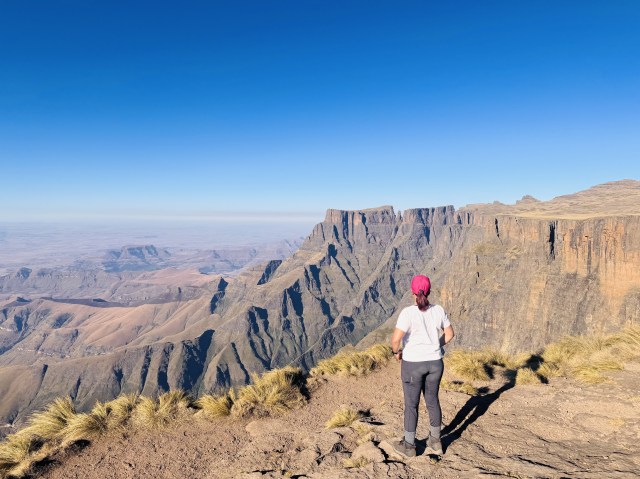
Standing at the brink, looking down nearly 1,000 meters into the abyss with the Drakensberg mountains rolling out below like gigantic, wrinkled green-and-brown velvet sheets, was genuinely overwhelming. We sat on a cold boulder, pulled out our slightly squished snacks, and drank lukewarm Energade as Jeff and Sipho prepared our campsite. The wind was biting (probably around -4°C windchill) but the silence was absolute.

As the sun dipped behind the western peaks, the temperature plummeted from a mild 8°C straight down to -3°C with windchill. We crawled into our sleeping bags dressed in full thermal gear, beanies, and wool socks, boiling water on our small camping stove for freeze-dried pasta and hot chocolate. The night was a test of endurance- the wind howled across the exposed flat plateau, slapping the tent canvas like a whip. Sleep came in quick 20-minute bursts, but every time I poked my head out the tent zipper, the sky above was a blinding canopy of billions of diamond-sharp stars, completely free of light pollution.


Gold Over the Abyss
At 05:45 AM, our frozen alarm buzzed. Unzipping the tent fly was like opening a freezer door. We dragged our pajama clad bodies toward the edge of the Amphitheatre cliff.

Standing on the cliff lip in complete silence as the first light broke is a memory that will stay with me forever. As the sun crested the horizon, it ignited the Royal Natal valley thousands of feet below us in molten shades of indigo, gold, and burning amber. The tops of the surrounding basalt peaks caught the light first, glowing like giant torches above a sea of clouds. Standing at 3,000 meters, watching the shadow of Sentinel Peak stretch out for miles across the golden winter grasslands while sipping hot chocolate, made every second of shivering completely worth it.
The Descent & The Verdict
Going down, as any hiker knows, is where your knees pay the bill. Descending the chain ladders required twice as much focus (looking down between your feet is a psychological test), and the switchbacks on the return journey felt twice as long as they had the day before.

By the time we got back to the Witsieshoek car park twenty four hours after starting, our calves were vibrating, our cheeks were wind-burned, and our toes were completely numb inside our boots. But as we collapsed into the car, heater blasting, I thought to myself: “Best worst idea we’ve ever had.”
Panda’s Rating Scale




Essential Advice for Hikers in Winter
- Fitness Level: You don’t need to be a marathon runner, but you do need endurance and mental grit. If you can walk 10–12 km on hilly terrain, you can manage this.
- Winter Gear: Wear windproof outer shells. The plateau wind in winter will slice straight through soft fleece. Bring quality gloves with good grip for the chain ladders.
- Water: The river on top might be frozen or low in winter—carry at least 2.5–3 liters per person.
- Safety: Weather changes in minutes. Always start early (by 07:00 AM) to finish hiking well before the winter sun drops at 17:30 PM.
- Sleeping Gear: Bring a sleeping pad with a high R-value (4+) and a sleeping bag rated to at least -5°C comfort. The frozen ground will sap your heat in minutes without insulation.
- Water Management: Store your water bottles inside your tent or sleeping bag overnight—otherwise, you’ll wake up to solid blocks of ice
If you want to read another account of hiking Tugela Falls in a different season, I recommend this post by Thinkadventure. It’s a fun read with some photos of Tugela in a different season. I also have a wealth of information on my Instagram. Do have a look. If you enjoyed this post about hiking Tugela Falls, please pin it using the pins below:


Have you considered a hiking Tugela Falls? Or have I just put it on your list? Let me know in the comments below!


2 Comments
As with many hikes, the views always make the tough part of climbing up there worth it! But reading this made me feel exhausted haha. Sounds like running a marathon even if there is no running 😮💨
This was the longest hike I have ever done and yes honestly thinking about it even now makes me feel exhausted. However I am happy you said reading about it made you feel tired because I want to dispel the widespread notion (at least in SA) that this is a very easy beginner hike. Its not. It requires forethought, planning and preparation. But the feeling of having made it to the top makes the struggle worthwhile!